




Does reverse osmosis remove PFAS? Yes—properly designed reverse osmosis can substantially reduce many PFAS in drinking water, including PFOA and PFOS. The membrane separates these compounds from the treated-water stream and sends them toward the drain with the concentrate water rather than destroying them inside the system.
Whether reverse osmosis reliably removes PFAS at the kitchen tap depends on the complete system’s verified claims, operating conditions, and proper maintenance—not simply the presence of an RO membrane.
That answer requires an important qualification. Reverse osmosis PFAS performance depends on the complete system, membrane condition, feed pressure, source-water chemistry, maintenance, and the specific PFAS being measured. No household system should be described as removing 100% of every PFAS unless model-specific testing supports that exact claim.
For homeowners asking how do you remove PFAS from drinking water, RO is one of the strongest point-of-use technologies to consider. EPA research has found that the RO systems studied can greatly reduce PFAS, while EPA and NSF both recommend looking for independently verified contaminant-reduction claims and replacing filters on schedule.
What Are PFAS and Why Are They Found in Drinking Water?
PFAS—per- and polyfluoroalkyl substances—are a large family of synthetic chemicals used in products and processes where resistance to heat, oil, grease, or water is useful. Past and current applications include firefighting foam, industrial manufacturing, stain-resistant treatments, food-contact materials, and water-repellent coatings.
Their strong carbon-fluorine bonds allow many PFAS to persist in the environment. They can move from contaminated soil or groundwater into private wells and public water sources. PFAS is a group name rather than one chemical: PFOA and PFOS are two well-known members, while other compounds can differ in chain length, structure, mobility, and treatment behavior.
How Does Reverse Osmosis Remove PFAS?
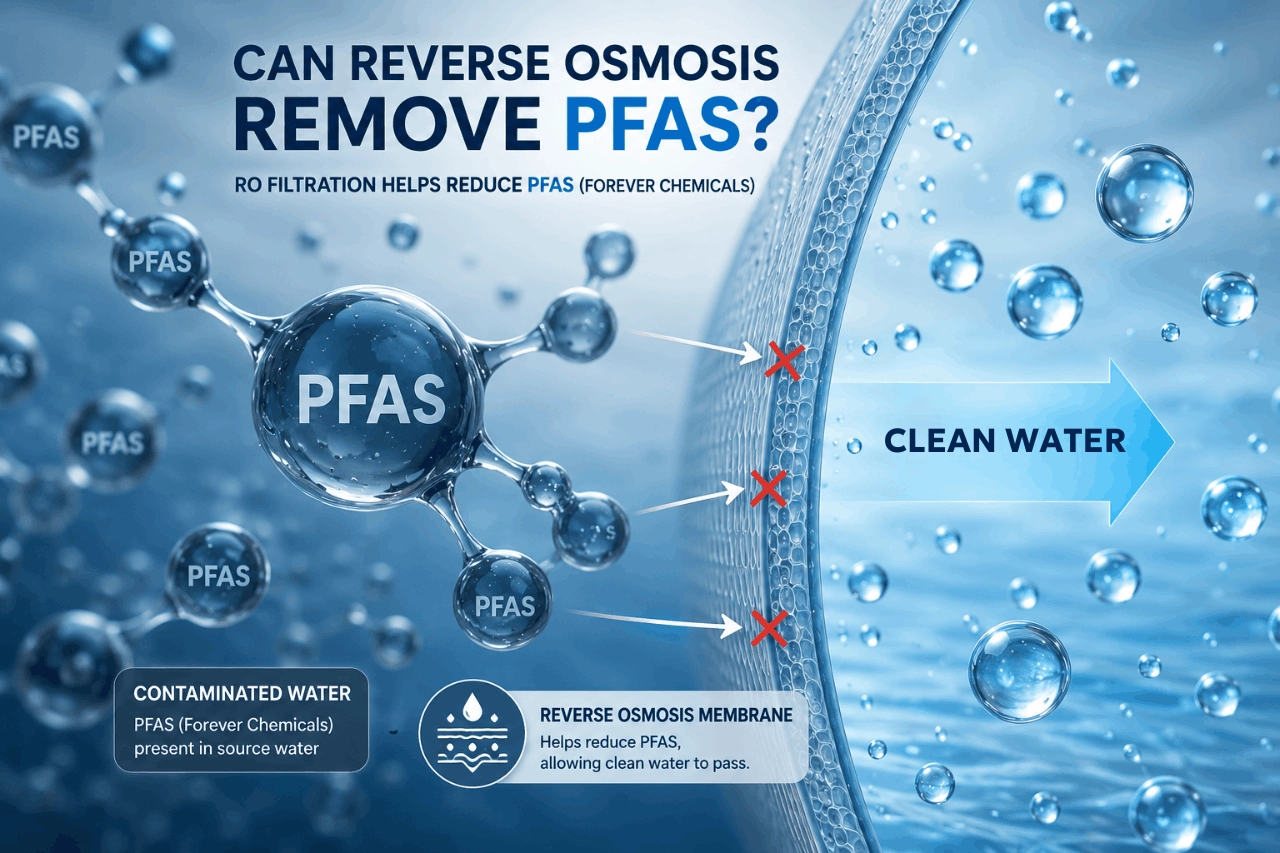
Reverse osmosis uses pressure to move water through a semipermeable membrane. Water molecules pass into the treated stream, while the membrane rejects a large share of dissolved salts and many organic contaminants. In reverse osmosis and PFAS treatment, the rejected compounds become concentrated in the drain stream, so correct installation and unobstructed drain flow remain important.
The membrane is not working alone. Sediment filtration helps prevent particles from fouling its surface, and activated-carbon prefilters protect common thin-film composite membranes from chlorine. Stable pressure supports separation performance, while timely cartridge changes help the membrane operate under its intended conditions.
A traditional Standard Reverse Osmosis System combines these stages with a storage tank that keeps treated water ready at the dedicated faucet.
How Effective Is Reverse Osmosis for PFAS Removal?
Reverse osmosis PFAS removal efficiency can be high, but one percentage cannot be applied to every system or every PFAS. EPA studies of selected point-of-use systems found strong reductions, yet results varied with the technology, operating conditions, water quality, initial concentration, and compounds tested. Laboratory performance also assumes correct installation and maintenance.
|
Factor |
Why it matters for PFAS reduction |
|
Verified reduction claim |
Shows that the complete model—not only one component— was evaluated for the stated PFAS claim |
|
Membrane condition |
Fouling, damage, poor seating, or overdue replacement can reduce separation performance |
|
Feed-water pressure |
Insufficient pressure can lower production and affect membrane performance |
|
PFAS chemistry |
Long- and short-chain compounds do not always behave identically during treatment |
|
Pretreatment |
Sediment and carbon stages protect the membrane and support stable operation |
|
Maintenance |
Filters and membranes must be changed according to the manufacturer’s service instructions |
The most useful comparison is therefore not stage count or a general marketing percentage. Check the model’s performance data sheet, the named PFAS covered by the claim, the rated service life, and the certification database. Reverse osmosis PFAS removal effectiveness is strongest when the installed system is matched to the tested configuration and maintained as specified.
Does Reverse Osmosis Remove PFOA and PFOS?
Does reverse osmosis remove PFAS and PFOS? The phrase mixes a group name with one member of that group, but the practical answer is yes: properly tested RO systems can significantly reduce PFOS as well as PFOA. These are among the best-studied PFAS and are commonly included in certification discussions.
However, a verified PFOA/PFOS claim does not automatically prove identical performance for every other PFAS. NSF indicates that PFAS claims for reverse osmosis systems are addressed under NSF/ANSI 58, while other residential filtration devices may use NSF/ANSI 53.
Can Reverse Osmosis Remove Short-Chain PFAS?
Short-chain PFAS can be more mobile and may be harder for some treatment media to capture consistently. High-pressure membranes can reduce many of these compounds, but performance varies. If short-chain PFAS is the concern, do not infer coverage from a PFOA or PFOS claim—look for testing that names the relevant compounds or a broader verified PFAS claim.
Which Aquaboon RO System Fits Your Household?
Aquaboon offers three RO formats for different household priorities. These model choices address capacity, storage, cabinet space, and taste preference.
RO Water Purification System — the traditional 50 GPD model with a storage tank. It provides a ready reserve at the faucet, uses a familiar multistage layout, and suits households with standard daily drinking-water demand that prefer a conventional serviceable system.
Smart RO Water Purification System — the high-flow 600 GPD Tankless Reverse Osmosis System that treats water on demand. It eliminates the separate tank, frees cabinet space, and supports higher use for drinking, cooking, and filling containers.
RO Water Purification System with Alkaline — the 600 GPD tankless option with an additional alkaline enhancement stage. It combines compact, high-flow operation with a more mineral-forward finished-water taste.
Does Remineralization Affect PFAS Removal?
The alkaline or remineralization stage is installed after the RO membrane. Its purpose is to adjust the taste and mineral profile of water that has already passed through the primary separation stage. It is not the main PFAS-removal component and should not be used as evidence of reverse osmosis PFAS removalperformance.
For households that prefer alkaline-enhanced water, the Tankless Reverse Osmosis System with Alkaline adds this post-membrane stage without changing the need to verify model-specific PFAS reduction claims.
Will Reverse Osmosis Remove PFAS?
Will reverse osmosis remove PFAS in every home? RO is one of the most effective household technologies available for reducing many PFAS, but results depend on the system and operating conditions. Test the source water when contamination is suspected, select a system with relevant independent verification, maintain it correctly, and consider post-treatment testing when PFAS is the main concern.
In short, do reverse osmosis systems remove PFAS? Many properly designed and tested systems can. Do reverse osmosis filters remove PFAS equally? No—membranes, configurations, claims, and maintenance differ. Does reverse osmosis filter out PFAS forever without service? No. Filter and membrane replacement are part of the treatment process.
Explore Aquaboon reverse osmosis systems, membranes, and replacement filters at Filterway to compare capacity, installation format, and maintenance needs for your household.
Frequently Asked Questions About Reverse Osmosis and PFAS
Can reverse osmosis remove all PFAS?
No system should be assumed to remove every PFAS completely. Performance depends on membrane design, the compounds present, operating conditions, maintenance, and the model’s verified reduction claims.
Does RO remove short-chain PFAS?
RO membranes can reduce many short-chain PFAS, but results vary by compound and system. Look for testing that names the relevant PFAS instead of relying only on PFOA/PFOS claims.
How often should an RO membrane be replaced for PFAS reduction?
Follow the manufacturer’s interval and performance guidance. Source-water quality and usage affect membrane life, so confirmed PFAS concerns may justify monitoring treated water rather than relying only on time.
How can I tell whether my RO system removes PFAS?
Review the model’s performance data sheet and certification listing. Confirm that the PFAS claim applies to the complete system and note exactly which compounds and service conditions are covered.
Should water be tested after installing an RO system?
Post-treatment testing is useful when PFAS contamination has been confirmed or strongly suspected. It verifies performance under the home’s actual water conditions and can support an appropriate maintenance schedule.